
Private Estates vs. Gated Communities

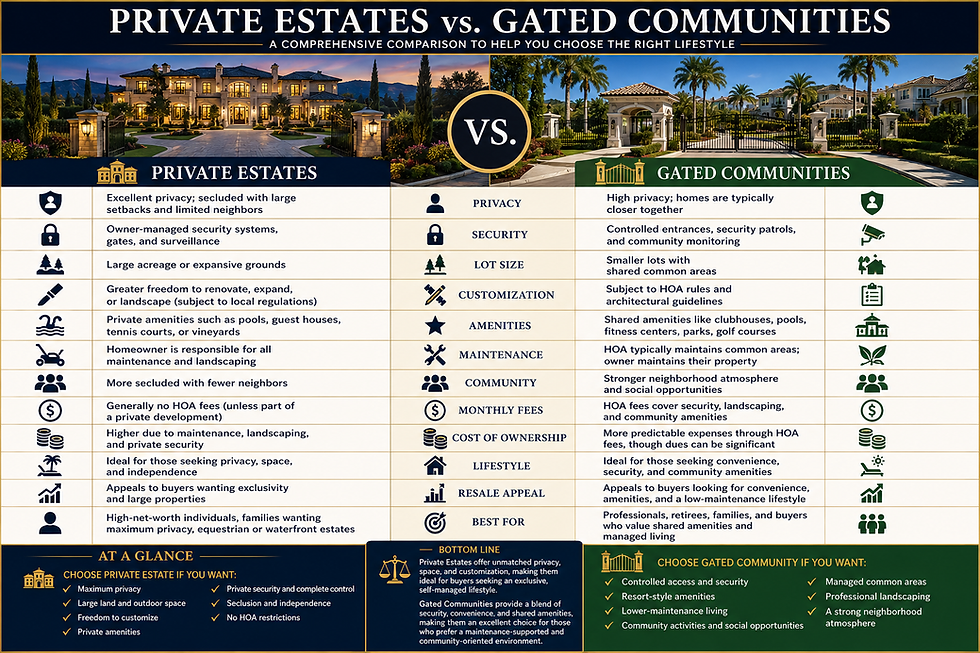
When searching for a luxury property, buyers often choose between a private estate and a home within a gated community. Both offer privacy, security, and upscale living, but they differ in ownership, amenities, maintenance, and lifestyle.
🏡 Private Estates
A private estate is a standalone property situated on its own parcel of land, often featuring expansive grounds and exclusive amenities.
Advantages
Maximum privacy with fewer nearby neighbors
Larger lots and greater outdoor space
Freedom to customize the home and landscape (subject to local regulations)
Space for amenities such as guest houses, tennis courts, equestrian facilities, vineyards, or private lakes
Greater sense of seclusion and exclusivity
Considerations
Owners are responsible for maintaining the home, grounds, and private roads (if applicable)
Security systems and staffing may be managed privately
Property upkeep can require more time and expense
Utilities and infrastructure may be more complex on large properties
🚪 Gated Communities
A gated community consists of multiple homes within a neighborhood that restricts access through controlled entrances.
Advantages
Controlled entry points and community security
Shared amenities such as:
Clubhouses
Fitness centers
Swimming pools
Tennis or pickleball courts
Walking trails
Golf courses (in some communities)
Landscaping and common-area maintenance are often managed by the homeowners association (HOA)
Strong sense of neighborhood and community activities
Considerations
HOA fees help fund shared services and amenities
Community rules may regulate exterior changes, landscaping, parking, or architectural styles
Lots are typically smaller than those of private estates
Privacy may be less than on a large standalone property
🔒 Privacy & Security
Private Estates
Greater physical separation from neighboring properties
Security is customized by the owner
Long private driveways, gates, and surveillance systems are common
Gated Communities
Controlled neighborhood access
Security patrols or staffed entrances may be available
Close proximity to neighbors can provide an additional sense of oversight
🌿 Lifestyle Differences
Choose a private estate if you value:
Complete privacy
Expansive land
Personalized amenities
Independence in property management
Choose a gated community if you prefer:
Shared recreational amenities
Lower responsibility for common-area maintenance
Social opportunities with neighbors
Organized community events and services
💰 Costs
Private estates may involve:
Higher maintenance costs
Private landscaping and security expenses
Larger utility bills due to property size
Gated communities often include:
HOA dues
Shared maintenance costs
Access to community amenities
Professional management of common spaces
📈 Resale Considerations
Both property types can offer strong long-term value, depending on:
Location
Construction quality
Market demand
Available amenities
Overall property condition
Buyers should also consider future maintenance costs and the desirability of the surrounding area.
✅ Comparison Checklist
Feature | Private Estate | Gated Community |
Privacy | ⭐⭐⭐⭐⭐ | ⭐⭐⭐⭐ |
Land Size | ⭐⭐⭐⭐⭐ | ⭐⭐⭐ |
Shared Amenities | Limited | Extensive |
Maintenance Responsibility | Owner | Shared for common areas |
HOA Rules | Usually none or minimal | Common |
Security | Customized | Community-managed |
Social Opportunities | Limited | Greater |
Customization Flexibility | High | May be restricted |
Choosing between a private estate and a gated community comes down to your priorities. If you value space, independence, and complete privacy, a private estate may be the better fit. If you prefer shared amenities, neighborhood services, and a lower-maintenance lifestyle, a gated community can provide an excellent balance of comfort, convenience, and security.

Comments